
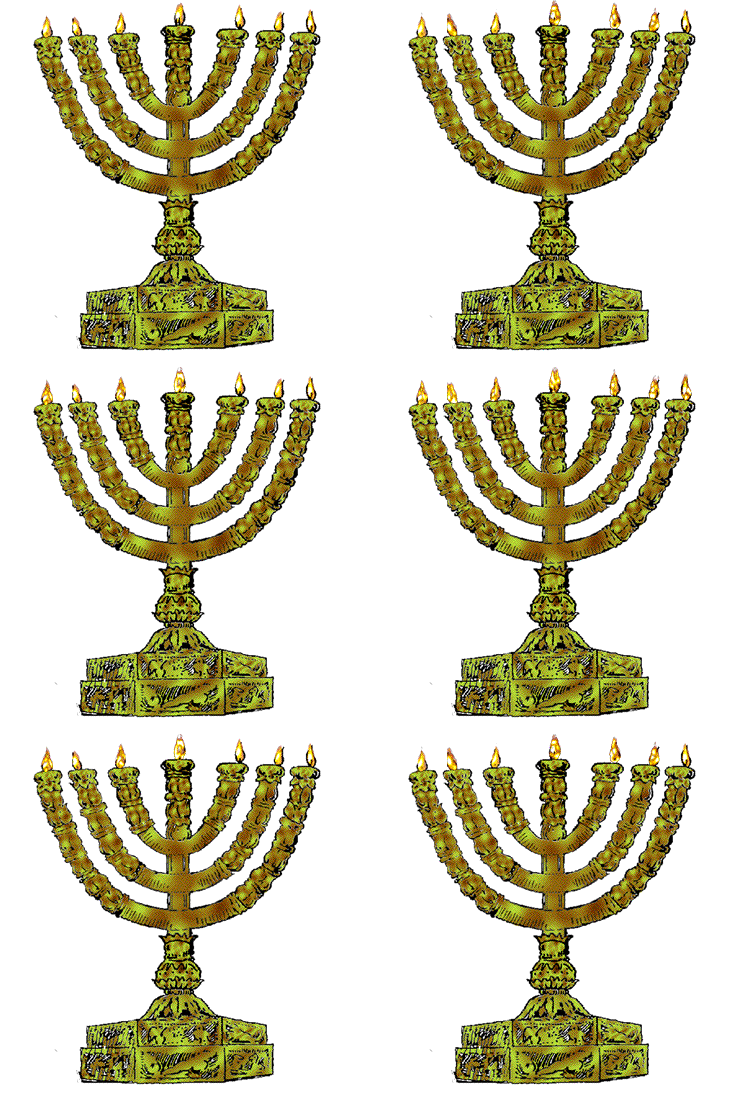
 The
Old Testament devotes considerable attention to describing the
portable tent, or tabernacle, of the Jewish people built under
the leadership of Moses. After the conquest of Canaan the tabernacle
and its contents remained at Shiloh throughout the time of Judges.
After Shiloh was destroyed (about 1050 BC), the Ark traveled through
various Philistine cities and finally was brought to David's palace
south of the Temple Mount in Jerusalem, and then into the holy
of holies of the First Temple dedicated by Solomon about 952 BC.
The
Old Testament devotes considerable attention to describing the
portable tent, or tabernacle, of the Jewish people built under
the leadership of Moses. After the conquest of Canaan the tabernacle
and its contents remained at Shiloh throughout the time of Judges.
After Shiloh was destroyed (about 1050 BC), the Ark traveled through
various Philistine cities and finally was brought to David's palace
south of the Temple Mount in Jerusalem, and then into the holy
of holies of the First Temple dedicated by Solomon about 952 BC.
The First Temple geometrically resembled the tabernacle though
it was twice as large and built of immense quantities of stone,
cedar wood and lined with gold. [See Exodus 25-31; 35-40, Numbers
3:25 ff, 4: ff, also Philo (II Mos. 91) and Josephus (Ant. 3:122
ff). Moses built everything according to a pattern revealed to
him on Mt. Sinai, Hebrews 8:5.]
After the First Temple was completed (I Kings 5-8), the Tabernacle
of Moses was dismantled. It may have been stored in a room under
the Temple Mount in Jerusalem. There is some evidence that it
may still lie there to this day.
Nebuchadnezzar destroyed Jerusalem and the First Temple on the
9th of Av 586 BC, the Jews were then taken captive to Babylon
and the city had no center of worship until Zerubbabel and the
returning exiles built the Second Temple, completing it in 516
BC.
The Second Temple, modest in comparison with its predecessor,
was rebuilt and enlarged by Herod the Great beginning in 20 BC.
Herod recruited 10,000 workman and set them to the task commencing
in the 17th year of his reign. Josephus gives vivid descriptions
of the Second Temple and its environs, and also records the terrible
destruction by the Roman general Titus in 70 AD
I Kings 6 ff, I Chronicles 22 ff. 3, Ezra, Nehemiah and Haggai
describe the rebuilding of the temple after the Babylonian captivity.
This is the so-called "Second Temple" which Herod the
Great later greatly enlarged. Jesus was dedicated in the Second
Temple, He cast out money chambers there on two occasions, and
He taught frequently in the temple courts.
During the 70 year captivity of the Jews in Babylon and again
in the diaspora, just ending in the last century, the Jewish people
have centered their worship of the God of Abraham, Isaac and Jacob
in synagogues around the world. Since the terrible destruction
of the Second Temple by the Romans in AD 70, temple sacrifices,
offerings, instruction, and worship have ceased in accordance
with an Old Testament prophecy of Hosea (about 746 BC):
"For the children of Israel shall dwell many days without king or prince, without sacrifice or pillar, without ephod or teraphim. Afterward the children of Israel shall return and seek the LORD their God, and David their king; and they shall come in fear to the LORD and to his goodness in the latter days." (Hosea 3:4,5)
The regathering of the Jewish people to their homeland in our
time (as predicted for example in Ezekiel 37) is being accompanied
by a rapidly accelerating religious consciousness in Israel, the
awakening of ancient longings and aspirations and the rediscovery
of many immutable promises God has made to the chosen seed of
Abraham. The fact that a Third Temple is to be built can be shown
from the Tanach. But three passages in the New Testament also
refer to such a building not now in existence as of this writing
in 1996 AD. Many Christians have thus speculated in recent years
about when the Third Temple would be built. This is considered
by many to be an important milestone pointing to the end of the
age.
The entire Temple Mount contains cisterns and passages most of
which have been inaccessible since 70 AD. The Temple Mount proper
was liberated from Jordanian control in the Six-Day War of 1967,
but then returned by Israel to the custody of the Muslim Waqf
(Jordan). The site is some 34 acres in extent with the prominent
"Dome of the Rock" near the center and Al Aqsa mosque
at the South end. Jews pray night and day at the Western Wall,
which is below the Temple Mount, along a section of the great
retaining wall of the Mount, in the Jewish Quarter of the Old
City. The Western Wall as close as Jews can get these days to
the site of their ancient temples.
Dr. Asher Kaufman, formerly of the Racah Institute of Physics,
Hebrew University, Jerusalem, for many years made careful
studies on Mount Moriah leading him to believe the Temples of
Solomon and Zerubbabel were both located just north of the Dome
of the Rock on the paved platform area. The Holy of Holies is
believed to have been approximately on the bedrock covered by
a small shrine, the Dome of the Spirits. The Muslim stewards of
the site have systematically destroyed or covered over all evidence
that the site was once important to the Jews or to Christians.
Others, including Dan Bahat the Dean of Jerusalem archaeologists
today, have argued persuasively that the First and Second Temples
were most certainly located where the present Dome of the Rock
shrine now stands. A third view is that of Architect Tuvia Sagiv
who presents striking evidence that the Temple location was South
of the Dome of the Rock, but North of Al Aqsa Mosque, under the
present Muslim El Kas fountain. (See Update at the bottom).
The Temple Mount area is also the location of the birth of the
Christian church at the feast of Pentecost which followed seven
sabbaths plus one day after the death of Messiah. Neither Christians
nor Jews are presently allowed to pray or worship on the site
in spite of its historic importance to all of Abraham's children.
To go back even further in time the Temple Mount has great historical
importance to the Jews. Abraham met a priest of the true God named
Melchidezek at Mount Moriah about 4000 years ago (Genesis 14,
Hebrews 5-7). A few years later, Abraham offered his son as a
sacrifice there (Genesis 22), and King David purchased the site
from a local resident named Ornan (I Chronicles 21), about 1015
BC.
Muslim claims to the Temple Mount date only from 638 AD. The Crusaders
turned the Muslim buildings on the Mount into churches in 1099
until Saladin restored Arab rule of Jerusalem in 1187.
The New Testament makes only brief references to temples, in fact
the Apostle Paul speaking to a crowd in Athens from Mars Hill
said
"The God who made the world and everything in it, being Lord of Heaven and earth, does not live in shrines made by man, nor is he served by human hands, as though he needed anything, since he himself gives to all men life, and breadth, and everything..." (Acts 17:24-25).
Instead, the emphasis of the New Covenant is the personal presence
of Jesus as Messiah, Immanuel (which means "God with us")
dwelling within and in the midst of his people whenever and wherever
they gather in his name.
The New Testament opens with the four-gospel revelation of God's
Son, Jesus. John in His gospel says that God in Christ "tabernacled"
among men. Later in the First Century, both Paul and Peter call
the true church "a living temple." Individual believers
are "living stones" and Christ is Himself the foundation
stone or the "chief cornerstone." For two thousand years
of Biblical history the emphasis has been on assemblies or congregations
of Christians or Jews, not on sacred buildings.
Yet there are at least three references in the New Testament to
a temple building existing in Jerusalem in the future as
noted above. From the context these references appear to refer
to a new, or "Third Temple" yet to be built in the city.
There has been growing interest since the rebirth of Israel in
1948 among the Jews for a central place of worship in their capital
city. Although synagogues have served admirably as centers of
worship and community for the Jews in their dispersion, a temple
in Jerusalem on the exact site of the Second Temple is required
by the Jews as a central house of prayer and focal point of the
faith until Messiah comes.
Because of our sins we were exiled from our country and banished from our land. We cannot go up as pilgrims to worship Thee, to perform our duties in Thy chosen house, the great and Holy Temple which was called by Thy name, on account of the hand that was let loose on Thy sanctuary. May it be Thy will, Lord our God and God of our fathers, merciful King, in Thy abundant love again to have mercy on us and on Thy sanctuary; rebuild it speedily and magnify its glory. (The Jewish Prayer Book)
According to Maimonides it is incumbent on the Jews to maintain
the temple in Jerusalem if it is in existence and to rebuild it
speedily if it does not. Many Jews acknowledge from the Tanach
that shedding of blood is associated with the remission of sins.
Thus the restoration of animal sacrifices in a properly consecrated
temple is seen as very important to them.
The Third Temple must be placed on the same spot of ground as
the First and Second Temples because of the Jewish concept of
zones of holiness on Yahweh's sacred mountain.
Jesus spoke of the Third Temple building in Jerusalem when discussing
with his disciples the chain of events that would bring the close
of the present age and his return. He spoke of an event yet future
predicted by Daniel the prophet when the temple in Jerusalem would
suffer ultimate defilement by a false Messiah who claimed to be
God:
"So when you see the desolating sacrilege spoken of by the prophet Daniel, standing in the holy place (let the reader understand), then let those who are in Judea flee to the mountains; let him who is on the housetop not go down to take what is in his house; and let him who is in the field not turn back to take his mantle. And alas for those who are with child and for those who give suck in those days! Pray that your flight may not be in winter or on a sabbath. For then there will be great tribulation, such as has not been from the beginning of the world until now, no, and never will be." (Matthew 24:15-21)
Since only a properly consecrated temple can be defiled, this passage implies a functioning, dedicated Third Temple and priesthood in existence in the end time at the time Jesus said he would return. The apostle Paul, writing a few years later, describes this same event:
"Now concerning the coming of our Lord Jesus Christ and our assembling to meet him, we beg you, brethren, not to be quickly shaken in mind or excited, either by spirit or by word, or by letter purporting to be from us, to the effect that the day of the Lord has come. Let no one deceive you in any way; for that day will not come, unless the rebellion comes first, and the man of lawlessness is revealed, the son of perdition, who opposes and exalts himself against every so-called god or object of worship, so that he takes his seat in the temple of God, proclaiming himself to be God," (2 Thessalonians 2:1-4).
The coming false Jewish messiah, resembling his predecessor
Antiochus Epiphanes (~175 BC), is the "worthless shepherd"
spoken of by the prophet Zechariah - and the man Jesus spoke of
when he said to the Jews, "I have come in my Father's name
and you would not receive me. Another will come in his own name,
him you will receive." (John 5:43) (See also Daniel 9:27,
Revelation 13:18)
Finally, the existence of the Third Temple in Jerusalem at the
close of the age is confirmed by the aged apostle John when he
recorded the Book of the Revelation:
"Then I was given a measuring rod like a staff, and I was told 'Rise and measure the temple of God and the altar and those who worship there, but do not measure the court outside the temple; leave that out, for it is given over to the nations, and they will trample over the holy city for forty-two months."' (Revelation 11:1-2)
In contrast to the earthly city the Book of the Revelation, the last book of the New Testament, describes the heavenly city New Jerusalem, descending from space, as a city which contains no temple at all:
"And I saw no temple in the city, for its temple is the Lord God the Almighty and the Lamb. And the city has no need of sun or moon to shine upon it, for the glory of God is its light, and its lamp is the Lamb." (Revelation 21:22,23)
Evidently the Third Temple has a limited life time and use
towards the close of the present age. Probably it will be destroyed
in the "great earthquake" which is described by Ezekiel
and in the Revelation as shaking Jerusalem just prior to the second
coming of Jesus Christ. In fact, at the time (all) "the cities
of the nations will fall."
Most Bible scholars agree that the end time tribulation period,
Daniel's "Seventieth Week," encompasses just seven years.
So it seems safe to say that the Third Temple may be built and
destroyed within a decade or two, perhaps less. It will probably
remain consecrated and undefiled for at least 3-1/2 years. [Concerning
the violent events and the great earthquake during the tribulation
period see Isaiah 29:1-8, Revelation 6:12, 8:5, 11:13, 16:18-21,
Ezekiel 38:19, Daniel 9:24-27, Zechariah 12-14.]
No one knows whether the Third Temple will be built before of
after what Christians call "the rapture of the true church."
Possibly the Third Temple will be built when the western political
leader known as the Antichrist makes a peace treaty between Arabs
and Jews, as predicted by Daniel the prophet. A rabbinical school
(or yeshiva) for the training of the priests for this temple is
presently in existence in the Old City. Sacred vessels and priestly
garments have been prepared. Cedar from Lebanon captured in the
north during the war there in 1982 has been placed in storage
for the next temple, and so on. Thus there has been considerable
preparation for the Third Temple by the religious Jews of modern
Jerusalem. Both the Ashkenazi and Sephardi Chief Rabbis of Jerusalem
agree that such a temple will be built as soon as circumstances
permit.
There may yet be a fourth Temple built in Israel-the prophet Zechariah
(c. 500 BC) says that Messiah, whom he calls the "Branch"
will yet build a temple in Israel:
"Take from them (the exiles) silver and gold, and make a crown, and set it upon the head of Joshua, the son of Jehozadak, the high priest, and say to him, 'Thus says the Lord of hosts, "Behold, the man whose name is the Branch: for he shall grow up in his place, and he shall build the temple of the Lord. It is he who shall build the temple of the Lord, and shall bear royal honor, and shall sit and rule upon his throne. And there shall be a priest by his throne, and peaceful understanding shall be between them both."' (Zechariah 6:13.)
Since orthodox Christians hold to a literal, physical return of Jesus, the construction of the Fourth Temple, they believe, would thus be the responsibility of their Lord, whom they believe to be Yeshua Hamashiach. This temple may well be that seen by Ezekiel (ca. 570 BC) in a vision. A temple that matches his description has never yet been built. Moreover, the Fourth Temple will evidently not be built at Jerusalem but possibly at Shiloh, some 31 km to the North:
"When you allot the land as a possession, you shall set apart for the Lord a portion of the land as a holy district, twenty-five thousand cubits long and twenty thousand cubits broad; it shall be holy throughout its whole extent. Of this a square plot of five hundred by five hundred cubits shall be for the sanctuary, with fifty cubits for an open space around it. And in the holy district you shall measure off a section twenty-five thousand cubits long and ten thousand broad, in which shall be the sanctuary, the most holy place. It shall be the holy portion of the land; it shall be for the priests, who minister in the sanctuary and approach the Lord to minister to him; and it shall be a place for their houses and a holy place for the sanctuary. Another section, twenty-five thousand cubits long and ten thousand cubits broad, shall be for the Levites who minister at the temple, as their possession for cities to live in."
"Alongside the portion set apart as the holy district you shall assign for the possession of the city an area five thousand cubits broad, and twenty-five thousand cubits long it shall belong to the whole house of Israel."
"And to the prince shall belong the land on both sides of the holy district and the property of the city, on the west and on the east, corresponding in length to one of the tribal portions, and extending from the western to the eastern boundary of the land. It is to be his property in Israel. And my princes shall no more oppress my people; but they shall let the house of Israel have the land according to their tribes." (Ezekiel 45:1-8.)

And also,
"Adjoining the territory of Judah, from the east side to the west, shall be the portion which you shall set apart, twenty-five thousand cubits in breadth, and in length equal to one of the tribal portions, from the east side to the west, with the sanctuary in the midst of it. The portion which you shall set apart for the Lord shall be twenty-five thousand cubits in length, and twenty thousand in breadth." (Ezekiel 48)
According to many Bible scholars, the fourth or "millennial
temple" (Ezekiel 40-45), will be memorial, a teaching center
to instruct men about the holiness of God and proper worship.
As sinful men and women continue to be born into the world in
the Millennium the temple is supposed to remind everyone of the
substitutionary death of Jesus on the cross, as the "Lamb
of God," some two thousand years earlier.
Though the Biblical emphasis is never on temple buildings but
on men and their character, scripture does not negate the use
of shadows and symbols. Literal physical realities are said to
be given in order to teach about the enduring, permanent spiritual
realities they point to.
"Thus says the Lord: 'Heaven is my throne and the earth is my footstool; what is the house which you would build for me, and what is the place of my rest. All these things my hand has made, and so all these things are mine, says the Lord. But this is the man to whom I look, he that is humble and contrite in spirit and trembles at my word."' (Isaiah 66:1, 2)
See Also:
The Temple of Ezekiel, by Lambert Dolphin
The
Coming Temple, by Jack Kelley



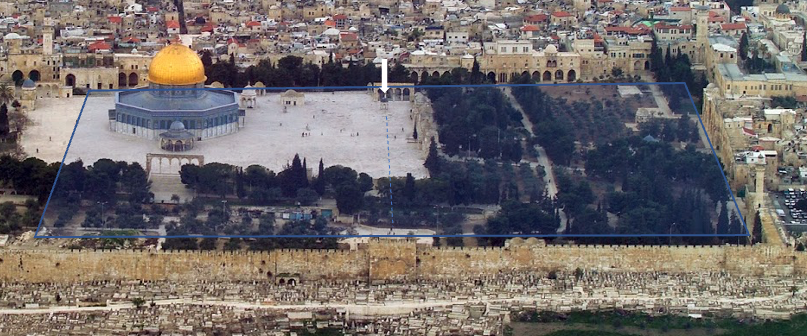 Christian Widener, PhD of has written an excellent book defending Asher Kaufmann"s thesis that the two Jewish Temples were located North of the Dome of the Rock--with the Holy of holies perhaps located under the Dome of the Spirits shrine.
Conservative rabbis in Israel today, including the great people at The Temple Institute are convinced that the First and Second Temples were located where the Islamic Shrine, the Dome of the Rock, now stands. In Israel, science, history, and reason don't always prevail over politics! Orthodox Jews do not believe that Jesus (Yeshua) is their promised Messiah. They see our gentile Jesus as too goy. But the real Messiah will come--he is their hope. Therefore it is incumbent on us to build and dedicate a Third Temple where messiah can officiate.
Since 1995, the independent web site Templemount.org has been online to present as much information as we could find on the history of the Temple Mount
Back about 1983. Stanley Goldfoot told me he knew an under-the-temple-mount renegade Jew who had seen the original tiled platform of the First and Second Temples while exploring at night the vast debris piles under the platform. Much has been learned since!
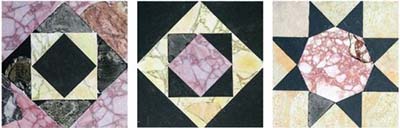
GEOMETRIC BEAUTY. Roman tiles found by the Temple Mount Sifting Project have patterns that are consistent with popular opus sectile patterns found throughout the Roman world in the first century B.C.E.–first century C.E. These patterns include two blocks comprising four squares arranged in a diamond design in each block (see left and center blocks) and an eight-pointed-star pattern in which eight triangles radiate from a central octagon (see right block). Photo: Temple Mount Sifting Project.
 One day Stanley Goldfoot and I were discussing Samson who pulled down the Temple of Dagon by pushing against the two main pillars.
From the Book of Judges
Now the lords of the Philistines gathered together to offer a great sacrifice to Dagon their god, and to rejoice. And they said:
“Our god has delivered into our hands
Samson our enemy!”
When the people saw him, they praised their god; for they said:
“Our god has delivered into our hands our enemy,
The destroyer of our land,
And the one who multiplied our dead.”
So it happened, when their hearts were merry, that they said,
“Call for Samson, that he may perform for us.” So they called for Samson from the prison, and he performed for them. And they stationed him between the pillars. Then Samson said to the lad who held him by the hand, “Let me feel the pillars which support the temple, so that I can lean on them.”
Now the temple was full of men and women. All the lords of the Philistines were there—about three thousand men and women on the roof watching while Samson performed. Then Samson called to the Lord, saying, “O Lord God, remember me, I pray! Strengthen me, I pray, just this once, O God, that I may with one blow take vengeance on the Philistines for my two eyes!” And Samson took hold of the two middle pillars which supported the temple, and he braced himself against them, one on his right and the other on his left. Then Samson said, “Let me die with the Philistines!” And he pushed with all his might, and the temple fell on the lords and all the people who were in it. So the dead that he killed at his death were more than he had killed in his life. And his brothers and all his father’s household came down and took him, and brought him up and buried him between Zorah and Eshtaol in the tomb of his father Manoah. He had judged Israel twenty years." (Judges 16:23-31)
I had just learned that Al Aqsa Mosque was supported at the South end of just one pillar.
Stanley immediately quipped, “Well then we’ll get a one armed Jew.”
Comments and Al Aqsa pillar photo added by Norma and Lambert April 11, 2021
 Second Edition of THE TEMPLE REVEALED, by author Dr. Christian Widener.
This second video has been extensively updated and expanded. It identifies the true location of the temple's of Solomon, Zerubbabel, and Herod in Jerusalem, using verifiable landmarks that have been hiding in plain sight. You can find the book THE TEMPLE REVEALED on most ebook retailers and on: Amazon or Barnes & Noble. Author Website and Blog.
Many recognize the prophetic predictions for a temple to be rebuilt in Jerusalem in the last days, but scholars have debated the true location for centuries, and there is currently no true consensus for the proper location. Not only that, but the location currently most favored, is where the Dome of the Rock is located, so until now, rebuilding has been considered impossible. Plus, the control of the site has been managed by the Islamic Waqf of Jordan since 1967, and they are not currently supportive of renewing a Jewish temple presence on the Temple Mount. But Jews have been praying for 1,950 years for a temple to be rebuilt. A place that Hashem has called the place of His throne and where the divine presence will rest His feet on Earth (Ezekiel 43:7). Isaiah 56:7 declares that God's house will be called a "house of prayer for all nations" so we are also looking for a rebuilt temple in fulfillment of biblical prophecy. And as a Christian, I see the rebuilding of the temple as a sign that the return of Jesus Christ, the Messiah of Israel, the Lamb of God, and Lion of Judah, is at hand. Finally, Daniel prophesied that there would be a temple rebuilt in the last days, so it seems good to delve into the historic accounts of the Temple Mount and to examine the existing archaeological evidence in order to try and determine the correct location. This is my second video on the temple. It includes all of the great evidence I presented in the first video and adds another 20 minutes of new content to make the case even clearer and to answer a lot of the questions that were generated from the first video.
Here are some of the new points addressed:
If you just want to watch one video that explains in detail how everyone can know for sure that the true temple location has been found, to see where it was, and to understand why it couldn't have been anywhere else...then you need to watch this video all the way to the end.1. Understanding the Ancient Terrain
2. How the Threshing Floor was Lost
3. Tradition and the Dome of the Rock
4. The Arch Under the Golden Gate
5. Aqueduct Levels & Cisterns
6. A Spring Under the Temple?
7. What About Fortress Antonia?
8. The Northern Fosse Objection
9. Why Does Any of This Matter?
And whether you're a Christian, a Jew, a Muslim, or an agnostic, if you have any interest at all in understanding the evidence for the temple's true location, then I hope you'll watch this video and discover the facts about how the location has been hiding in plain sight.
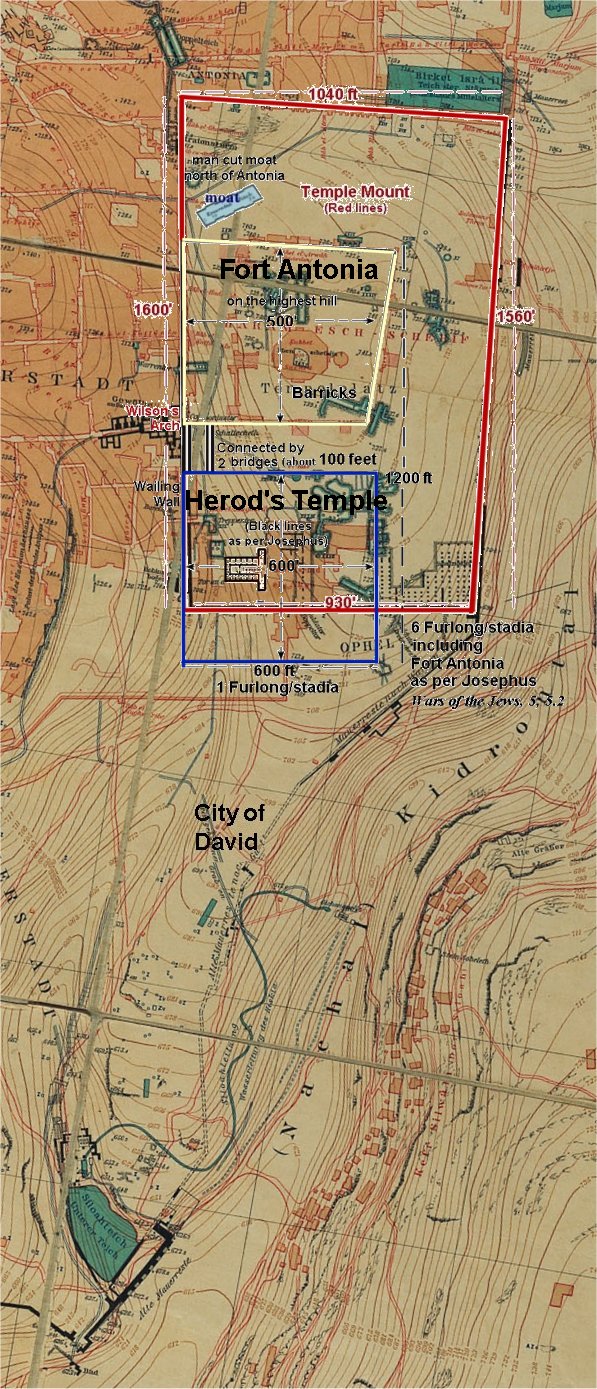

added June 25, 2021

Lambert Dolphin
Email Lambert
Lambert Dolphin's Library
The Temple Mount Web Site
October 8, 1990. September 25, 2002. April 11, 2021. June 8, 2021. June 25, 2021. July 14, 2021.